How Tree CheckUp® Inspections Actually Work (Step-by-Step)
Most tree issues aren’t obvious. That’s why there’s a process.
When you walk a property, most trees look fine.
Green leaves. Full canopy. Mature structure.
But appearances don’t tell the whole story.
The reality is:
- Different problems can produce the same visible symptoms
- Some issues take years to show up
- And what looks minor today can reflect something deeper
That’s why tree evaluations aren’t based on quick opinions.
They follow a structured diagnostic process.
The goal isn’t to guess, it’s to understand
A Tree CheckUp® Inspection isn’t about labeling a tree as “good” or “bad.”
It’s about answering a more useful question:
What’s actually going on here, and what does it mean for ownership?
Tree and plant evaluations aren’t based on guesswork.
They follow principles taught through university programs and used across the arboriculture industry.
These approaches emphasize observation, pattern recognition, site evaluation, and evidence-based conclusions, not quick assumptions.
A Tree CheckUp® Inspection applies those same principles to a homebuying decision.
To do that, we follow a step-by-step approach.
Step 1: Identify the Tree and What’s Normal
Before anything else, we establish:
- What species of tree is it
- How it typically grows
- What’s considered normal for that tree
Because what looks like a problem on one tree…
…might be completely normal on another.
Misidentification is one of the fastest ways to get a tree wrong.
Step 2: Look for What Stands Out
Next, we look for visible indicators across the tree:
- Leaf color, size, and density
- Canopy fullness or thinning
- Deadwood or dieback
- Cracks, cavities, or unusual growth
These are called symptoms of what the tree is showing on the outside.
But symptoms alone don’t tell the full story.
Step 3: Pay Attention to Patterns
This is where most people miss things.
It’s not just what you see, it’s where and how you see it.
We look for patterns like:
- Is it in the upper canopy or the lower canopy?
- One side of the tree or throughout?
- New growth or older growth?
- Is it isolated, or affecting multiple trees?
These patterns help narrow down what might be happening.
Step 4: Evaluate the Root Zone and Site Conditions
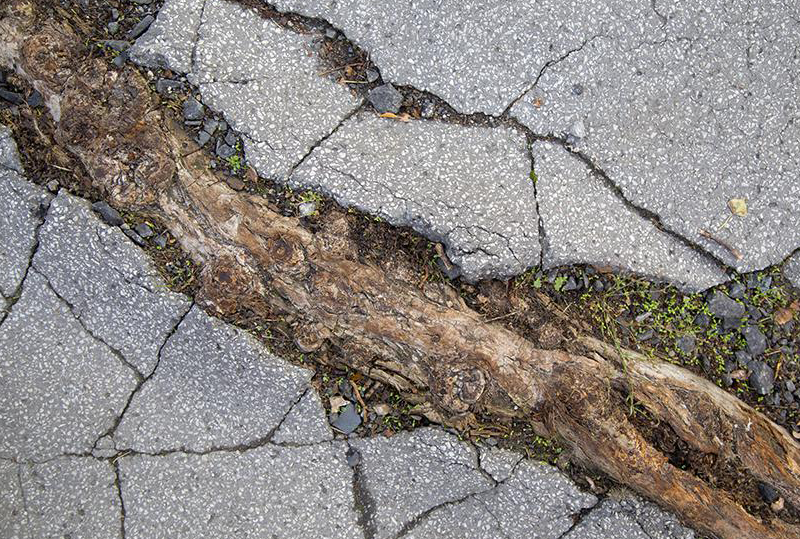
Many tree issues don’t start in the canopy.
They start at the base of the tree or below it.
We assess:
- Soil condition (compaction, drainage, moisture)
- Root flare visibility
- Signs of buried roots or girdling roots
- Mulch placement
- Past disturbance from construction or grading
A healthy tree above ground depends on what’s happening below it.
Step 5: Consider What the Property Has Been Through
Trees respond to change sometimes slowly.
We look at:
- Construction history
- Changes in grade or drainage
- Irrigation patterns
- Environmental stress (drought, flooding, heat)
A tree might be reacting today to something that happened years ago.
Step 6: Look at the Big Picture
At this stage, we step back and ask:
Does everything we’re seeing make sense together?
Because trees don’t usually have just one issue.
It’s often a combination of:
- Site conditions
- Biological factors
- Environmental stress
- Time
This is where experience and structure come together.
And this is where most quick opinions fall apart because what looks simple rarely is.
Step 7: Form a Defensible Conclusion
There’s a core principle taught in plant diagnostics:
Don’t make the symptoms fit the diagnosis—make the diagnosis fit the symptoms.
This approach is widely emphasized in university and industry training because many different issues can produce the same visible symptoms.
Without a structured process, it’s easy to reach the wrong conclusion.
That means:
- No jumping to conclusions
- No guessing based on one visible issue
- No defaulting to the most obvious answer
Instead, we build the most accurate explanation possible based on what’s observed.
Step 8: Organize Findings for Ownership
Once the evaluation is complete, the findings are translated into something useful for a homebuyer.
Not technical jargon.
Not a treatment plan.
A clear understanding of what it means for ownership.
We organize observations into:
- What appears consistent with normal ownership
- What may need attention sooner than expected
- What can be planned for over time
So you’re not just seeing the trees, you’re understanding them.
This is the process behind a Tree CheckUp® Inspection—applied before you close, not after.
Why this process matters (and why experience still matters)
Understanding the steps is one thing.
Applying them correctly in the field is another.
Tree evaluation isn’t just about following a checklist; it’s about knowing what matters, what doesn’t, and how different factors interact in real-world conditions.
That only comes from experience.
A trained and qualified tree professional brings:
- Years of field observation across different species and site conditions
- The ability to recognize patterns that aren’t obvious at first glance
- Judgment developed from seeing how trees actually respond over time
The process provides the structure.
Experience is what makes that structure reliable.
Why this process matters
Without a structured approach:
- It’s easy to misread what you’re seeing
- It’s easy to jump to the wrong conclusion
- And it’s easy to overreact—or miss something important
Two people can look at the same tree and walk away with completely different opinions.
The difference is the process behind the evaluation.
How does this fit into buying a home
A Tree CheckUp® Inspection applies this process before you close.
So instead of:
- Guessing
- Relying on quick opinions
- Or find out later
You understand:
- What’s normal
- What stands out
- And what it means for the property you’re about to own
Related questions homebuyers often ask
If you’re thinking through this, these are usually the next questions that come up:
- Do I actually need a tree inspection before buying a home?
- What do trees near a house really mean for ownership?
- How do trees affect maintenance, insurance, and long-term costs?
(We’re building out clear answers to each of these in the Learning Center.)
The simple version
Tree issues aren’t always obvious.
That’s why a Tree CheckUp® Inspection follows a structured process, so you’re not relying on assumptions when making a major decision.
If you’re under contract, this is the window
👉 See What a Tree CheckUp® Inspection Costs, Before You Close
👉 Schedule your Tree CheckUp® Inspection here.